A Headline Is Not the Whole Summary
Learn how to read a news headline against the story’s claims and qualifications, so you can tell what is emphasised, what is omitted and what remains uncertain.
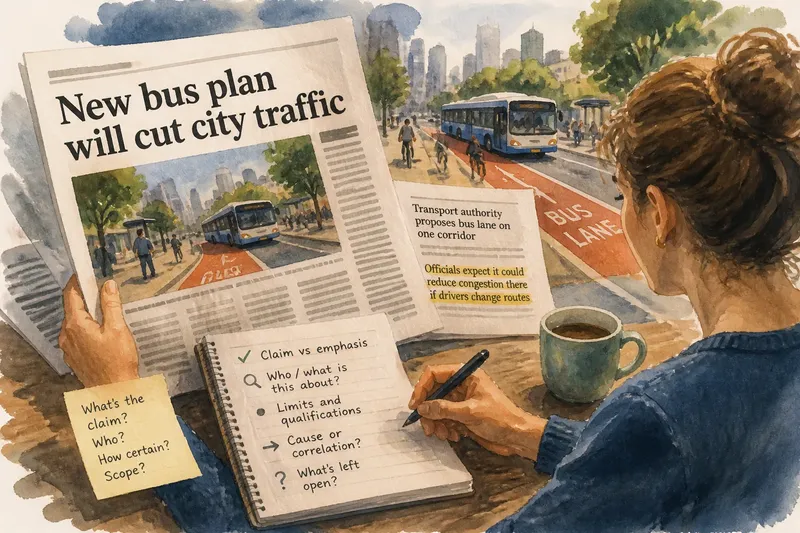
A news headline can make a qualified finding sound settled, or turn one detail into the story’s main point. To read a headline without mistaking it for a complete summary, compare its wording with the article’s claims, caveats and scope. The useful question is not simply whether the headline is accurate, but what impression it creates before you read the evidence beneath it.
How can you compare a headline with the story?
- Separate the headline’s claim from its emphasis. First, put the headline into plain words: what does it say happened, changed or was decided? Then ask which part receives the attention. A headline may accurately report that a council approved a plan while foregrounding the most contentious feature, leaving the plan’s purpose or limits for the article. Accuracy and emphasis are related, but they are not the same judgement.
- Find the sentence that states the central claim. Look near the beginning for a direct account of what the report says, rather than assuming the opening line will repeat the headline. Some stories lead with a vivid scene, a person’s reaction or background before setting out the principal finding. Scan for the sentence that explains the event or claim in straightforward terms, then compare its subject and verb with those in the headline.
- Check who or what the claim is about. Headlines often have little room to identify the full subject. “Schools face new rule” could refer to every school, a particular group of schools or only institutions covered by a proposal. The article may narrow the scope to one area, a named organisation or a specific stage of a decision. Keep that boundary attached to the claim when you describe it to someone else.
- Look for the words that set the limits. Terms such as “some”, “may”, “proposed”, “in one district” and “according to the council” can change what a sentence means. A short headline may leave these qualifications out for space, while the body includes them. Check whether the article describes a possibility as a possibility, distinguishes a proposal from a rule already in force, and makes clear when a claim belongs to a source rather than the reporter.
- Notice whether a result is being presented as a cause. A report may say two events occurred together, while a headline suggests one produced the other. Read the article’s explanation of how the connection was established. If it reports an association, a sequence or a source’s interpretation rather than a demonstrated cause, retain that distinction. The headline’s brisk wording should not make the article claim more than it does.
- Compare the headline’s level of certainty with the article’s. Words such as “will”, “ends” or “proves” can sound conclusive. The story may instead describe a forecast, an early indication or a decision that still depends on a later review. Find the passage that explains what is known now and what remains open. A confident headline is not, by itself, evidence that the underlying account is equally definite.
- Read the qualification where it appears, not only the first screen. A caveat may be in a later paragraph, a caption, a linked document or the description of how a figure was compiled. Reading beyond the opening helps establish whether the headline’s broad wording is narrowed elsewhere. It also prevents a correction in your own understanding: the opening may provide the hook, while a later section explains the conditions that give the claim its proper shape.
- Ask what a reader would repeat after seeing only the headline. Imagine you have twenty seconds before passing the story on. What one-sentence account would you give? Compare that sentence with the article’s central claim and limitations. If your version would make a tentative proposal sound final, or extend a local result to everyone, the headline alone has not supplied enough context for a fair retelling.
What does the headline leave open?
Does a question in the headline answer itself?
A question headline may present an issue for the story to examine rather than state a conclusion. Read the article to see whether it answers the question, reports competing views or explains why the answer is not yet clear. Do not turn the question into a factual claim when you discuss the story.
Can a headline quote a source without endorsing it?
A quoted phrase can be the source’s wording, not the reporter’s conclusion. Check who said it and how the article tests or contextualises the claim. If the story records a denial or allegation, keep the attribution attached when you summarise it.
What if the headline and opening seem to disagree?
Read further before deciding that one sentence settles the matter. The opening may add a condition, identify a narrower group or explain that the headline refers to a particular part of a larger story. If the difference remains material, describe the article’s wording precisely rather than supplying a certainty it does not offer.
Should you share a story based on its headline?
For a consequential claim, read enough of the article to understand its scope and qualifications before sharing. If you cannot access the full story, avoid presenting the headline as a verified, complete account; share it with wording that makes clear you have seen only the headline.
How can you test the difference in practice?
Say you see the headline “New bus plan will cut city traffic”. The opening says the transport authority has proposed a bus lane on one corridor, and the article later reports that officials expect it to reduce congestion there if drivers change their routes. A careful retelling would be: “The authority has proposed a bus lane, which officials expect could reduce congestion on that corridor.” That version keeps the proposal, source and limited location visible instead of converting a forecast into a settled citywide result.
This kind of comparison is useful because headlines have to compress a story, while an article has room to state conditions and distinctions. Compression does not automatically make a headline misleading; a short title may be a fair pointer to the central issue. The reader’s task is to check whether the article supports the impression the wording creates, not to assume either that every omission is deceptive or that every headline is a sufficient account.
When is a headline a fair shorthand?
A headline works as shorthand when it points towards the story’s main claim without changing its subject, certainty or reach. A reader should be able to add the article’s key qualification without having to reverse the basic meaning. If the headline says a proposal is under consideration and the article says the same, the compact wording may be fair even though it leaves out detail.
Be more cautious when the headline uses a broad label for a narrow case, turns a source’s opinion into an unqualified statement, or makes an unresolved outcome sound decided. Also notice what the story itself does not establish. An article can clarify a headline’s scope, but it cannot make an unsupported conclusion sound supported merely by adding more paragraphs.
When you need to pass a story on, keep the headline’s subject and the article’s most important qualification together in one sentence. For a headline comparison, that small habit is more useful than trying to remember every detail: say what the story claims, who or what it covers, and what remains conditional. The result is a compact summary that does not ask a headline to do the work of the whole report.